
Epoxy vs. Polyurethane Crack Injection in Tampa Bay: Which Concrete Repair Is Right?
⚡ Quick Answer
Epoxy injection is for stable, dry cracks that need to be welded back into one solid piece to restore structural load-bearing capacity. Polyurethane injection is for cracks that move, leak, or stay damp, sealing with a flexible, water-reactive barrier.
Pick the wrong one and the crack comes back, often within a single season. If the crack is wet or actively leaking, use polyurethane. If it is dry, stable, and carries weight, use epoxy.
If you own a home or business in Tampa, St. Petersburg, Clearwater, Brandon, or anywhere around Tampa Bay, you have probably found a crack in a concrete floor, slab, garage, or wall and asked the same question: “Should I use epoxy or polyurethane to fix it?”
The short answer: epoxy is for cracks that need to be welded back into one solid piece. Polyurethane is for cracks that move, leak, or stay damp. Pick the wrong one and the crack comes back, often within a season.
Tampa Terrazzo has restored floors across the Tampa Bay area for more than 48 years, and on the concrete repair side we see the same mistake again and again: a hardware-store epoxy kit pumped into a wet, moving crack that reopens the first rainy summer. This guide explains how each method works, when to use it, what it costs, where DIY makes sense, and how long each repair lasts, so you can make the right call the first time.
In this guide
- Epoxy vs. polyurethane at a glance
- How each crack injection method works
- When to use epoxy: the structural, rigid-bond use case
- When to use polyurethane: the flexible, moving-crack, moisture use case
- Decision framework: which should you choose?
- Quick reference by crack type and cause
- When to call a structural engineer first
- Cost comparison: epoxy vs. polyurethane injection
- DIY injection kits vs. professional injection
- How long does each repair last?
- Why Tampa Bay concrete cracks differently
- Common Tampa Bay crack scenarios and the usual fix
- What to do right now if you found a crack
- Why Tampa Bay property owners choose Tampa Terrazzo
- Frequently asked questions
Quick Answer: Epoxy vs. Polyurethane at a Glance
| Feature | Epoxy Injection | Polyurethane Injection |
|---|---|---|
| Main purpose | Structural bonding | Waterproofing and flexibility |
| Cured result | Rigid, very strong | Flexible, rubber-like or foam |
| Best for | Stable, dry cracks that need strength restored | Leaking, damp, or moving cracks |
| Works in wet cracks? | Poorly (standard epoxies need a dry crack) | Yes, it reacts with water |
| Handles movement? | No, a rigid bond can re-crack | Yes, it flexes with the slab |
| Typical use | Slabs, beams, columns, foundation walls, floors under load | Basement walls, planters, joints, pool decks, leaking slabs |
| Typical lifespan | 20+ years when the cause is fixed | 10-15+ years, often longer when protected |
How Each Crack Injection Method Works
How Epoxy Crack Injection Works
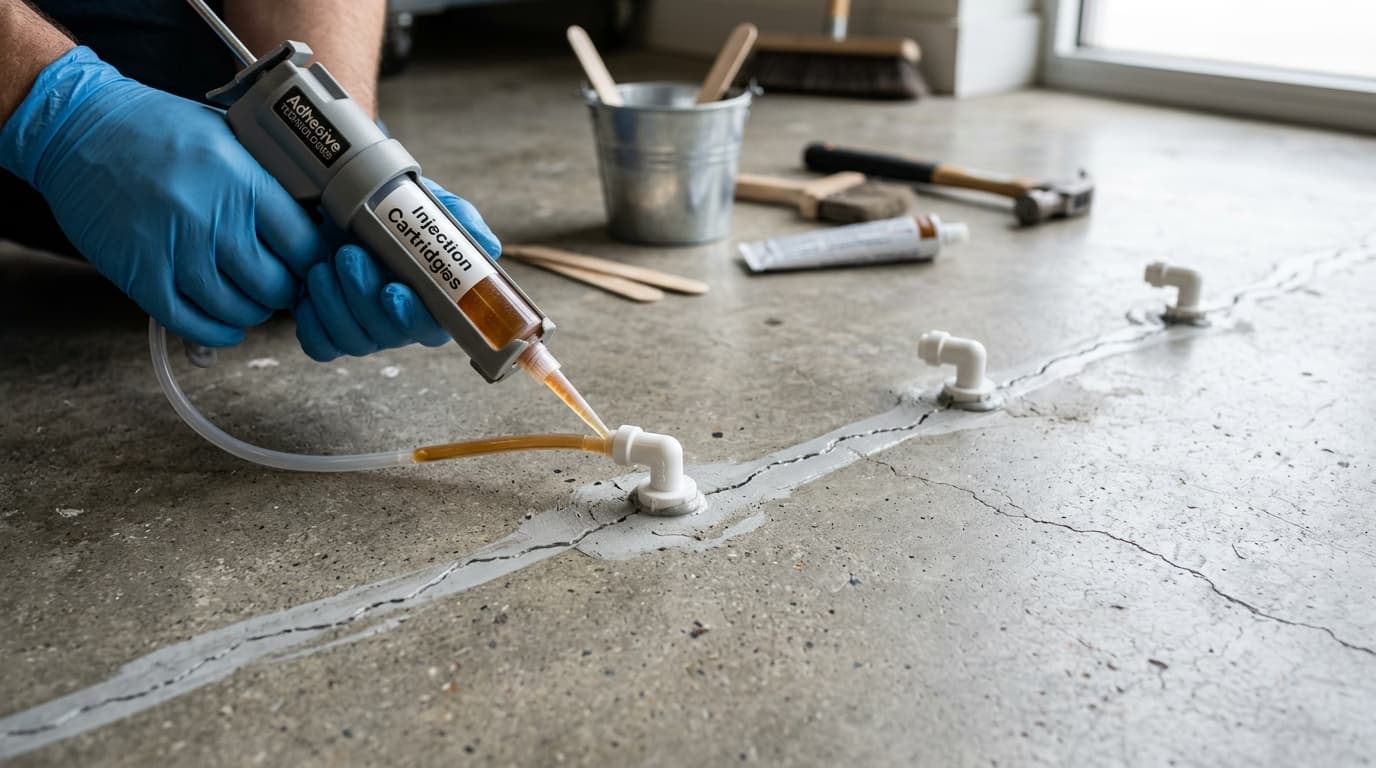
Epoxy injection is a pressure-fill repair. A two-part, low-viscosity epoxy resin (thin enough to flow into cracks as narrow as a hairline) is mixed and forced into the crack under controlled pressure.
The process, step by step:
- Clean the crack: Dust, oil, and debris are removed so the epoxy can bond to clean concrete.
- Install injection ports: Small plastic ports are set along the crack, spaced roughly according to the thickness of the concrete.
- Seal the surface: A fast-setting paste seals the face of the crack so the resin cannot leak out.
- Inject from the lowest point up: Resin is pumped in until it appears at the next port, which confirms the crack is filled all the way through.
- Cure and finish: After curing, ports and sealing paste are removed and the surface is ground flush.
Once cured, epoxy often becomes as strong as or stronger than the surrounding concrete. It does not just plug the crack. It bonds the two faces together so load can travel across the crack again.
How Polyurethane Crack Injection Works
Polyurethane injection uses the same basic idea (ports, sealing, pressure), but the chemistry is completely different. Polyurethane resins are designed to react with water.
- Hydrophobic (foam) polyurethane: Reacts quickly with water, expands into a dense foam, and packs the crack to stop active leaks fast.
- Hydrophilic (gel) polyurethane: Absorbs water and forms a flexible gel, sealing the crack and staying elastic even when the concrete gets wet and dries repeatedly.
As the resin travels through the crack, moisture triggers the reaction, so it expands and fills voids, then cures into a flexible seal. Because it stays flexible, it can stretch and compress with small seasonal movements, which rigid epoxy cannot.
Key difference in one sentence: Epoxy glues concrete back together; polyurethane seals the crack and lets it flex.
When to Use Epoxy: The Structural, Rigid-Bond Use Case
Choose epoxy injection when the goal is to restore strength and the crack is stable and dry.
Epoxy is the right choice for:
- Structural cracks in slabs, beams, columns, and foundation walls where load needs to transfer across the crack
- Garage and warehouse floors under vehicle or equipment traffic
- Shrinkage cracks that have stopped growing and need to be re-bonded
- Cracks that interrupt a finished floor (polished concrete, terrazzo, decorative overlays) where a hard, flush repair is needed
- Dry interior cracks with no moisture coming through
Why it works: Rigid epoxy takes load and prevents the two sides of the crack from shifting against each other. On a floor that carries weight, that matters.
Where epoxy fails:
- Cracks that are still moving: If the slab keeps shifting, the rigid epoxy bond just cracks again, often next to the old repair.
- Cracks that are actively leaking or constantly damp: Standard epoxy does not cure properly against water.
- Cracks where the underlying cause was never fixed: Structural or subgrade issues must be stabilized first.
When to Use Polyurethane: The Flexible, Moving-Crack, Moisture Use Case
Choose polyurethane when the priority is stopping water or the crack moves.
Polyurethane is the right choice for:
- Leaking or seeping cracks in basement walls, stem walls, retaining walls, and below-grade slabs
- Cracks that stay damp even in dry weather
- Control joints, cold joints, and expansion gaps that need a flexible seal
- Cracks with seasonal movement caused by temperature swings or changing soil moisture
- Pool decks, planters, tanks, and water features that must stay watertight
- Emergency leak stops, because foam polyurethane can seal an active leak within minutes
Why it works in Tampa Bay: Tampa Bay sits on sandy soil with a high water table, heavy summer rain, and hurricane-season downpours. Slabs and walls here see moisture and soil movement constantly. In those conditions, a flexible, water-tolerant seal often outlasts a rigid one. We explain more in our guide on what Florida’s humidity does to hard surfaces.
Where polyurethane falls short:
- It does not restore structural strength. It seals; it does not bond the concrete back to full capacity.
- Foam versions can shrink slightly if they dry out completely over time.
- It is not the right choice for a floor that needs to carry heavy point loads across the crack.
Decision Framework: Which Should You Choose?
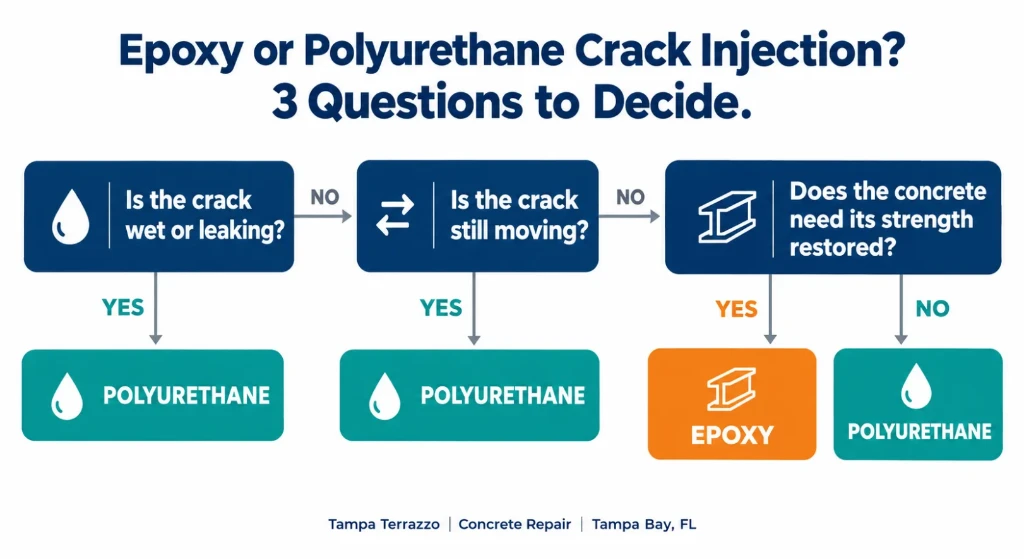
Use these three questions, in this order:
Question 1: Is the crack wet or leaking?
Yes: Polyurethane. (If strength is also required, a professional may stop the water with polyurethane first, then follow with epoxy once the crack is dry.)
No, it is dry: Go to Question 2.
Question 2: Is the crack still moving?
Place a marker at each end of the crack and measure its width over a few weeks, or have a pro install a crack monitor.
Yes, it widens, narrows, or shifts with the seasons: Polyurethane (or a flexible sealant). Epoxy will likely re-crack.
No, it has been stable: Go to Question 3.
Question 3: Does the concrete need its strength restored?
Yes (structural slab, load-bearing, floor traffic): Epoxy.
No, it is cosmetic or only a water path: Polyurethane is usually enough and often cheaper.
Quick Reference by Crack Type and Cause
| Crack Type / Cause | Typical Appearance | Best Repair |
|---|---|---|
| Plastic or drying shrinkage (stable) | Hairline, random or map-like, appeared in the first months | Epoxy if strength or appearance matters; sealer for purely cosmetic |
| Settlement or differential movement | One side higher; widening or diagonal | Fix the soil or support first, then a flexible repair (polyurethane) or monitor; engineer review if displaced |
| Thermal or seasonal movement | Opens and closes through the year | Polyurethane or flexible joint sealant |
| Overloaded slab (structural) | Wider cracks, often with scaling or deflection | Epoxy for bonding, after an engineer confirms the cause |
| Water-pressure / hydrostatic leaks | Seeping, efflorescence, damp patches | Polyurethane |
| Cold joint or construction joint leak | Straight line where pours met | Polyurethane |
| Stable crack in a polished or terrazzo floor | Visible line in a finished surface | Epoxy injection, then finish and re-polish to blend |
Important: Injection treats the crack, not the cause. If tree roots, poor drainage, a settling slab, or a plumbing leak is causing the movement, fix that first or the crack will return no matter what resin you use.
When to Call a Structural Engineer First
Stop and consult an engineer if you observe any of the following warning signs:
- Cracks wider than about 1/4 inch
- Stair-step cracking in concrete block walls
- One side of the crack noticeably higher than the other
- Doors or windows that suddenly stick or fail to latch
- A crack that keeps actively growing wider or longer
- Any suspected sinkhole activity (a genuine concern across parts of Hillsborough and Pasco counties)
If the damage follows a storm, flood, or suspected sinkhole, talk to your insurer before starting repairs and keep dated photos and measurements. Standard homeowner policies generally exclude ordinary settling and cracking, and coverage varies by policy.
Cost Comparison: Epoxy vs. Polyurethane Injection
Prices vary by crack length, depth, access, and site conditions. These are general planning ranges for the greater Tampa Bay area:
| Metric | Epoxy Injection (Tampa Bay Area) | Polyurethane Injection (Tampa Bay Area) |
|---|---|---|
| Typical professional cost | $25–$65+ per linear foot ($400–$1,000+ per crack) | $20–$55+ per linear foot ($400–$800+ per crack) |
| Typical minimum service call | $400–$800 | $400–$800 |
| Material cost | Higher for structural-grade high-viscosity resin | Varies by foam vs. gel expansion formulation |
| Labor | Slightly more prep (clean, dry, port, surface seal) | Faster installation; tolerates active moisture and wet leaks |
| Best value when... | You need structural strength restored once and for all | You need to stop active water leaks or handle joint movement |
What drives the price up:
- Long or deep cracks, or situations where both sides of a wall must be accessed
- Tight access (crawl spaces, interiors with fixed cabinetry or heavy machinery)
- Cracks that must be thoroughly dried or dammed before injection
- Finish work, such as diamond grinding and repolishing a decorative floor
- Emergency or after-hours active flood/leak response
Cost to avoid: Paying for the cheaper repair and then paying again. An epoxy injection into a moving, wet crack that fails in six months costs far more than the correct polyurethane repair the first time. Full slab replacement is many times more expensive than either injection.
DIY Injection Kits vs. Professional Injection
DIY kits are sold at big-box hardware stores and online for roughly $30–$100. They have a place, but a strictly limited one.
Where DIY Is Appropriate
- Short, narrow, stable, dry cracks in a garage, shed, or patio slab
- Cosmetic repairs where load-bearing strength is not critical
- Hairline shrinkage cracks you have monitored and verified are completely stable
- Situations where you are comfortable following chemical mixing ratios exactly
Where DIY Usually Goes Wrong
- Structural cracks: If the slab carries load, the repair needs verified high-pressure equipment and structural resin.
- Wet or leaking cracks: Most DIY epoxy will fail to cure properly in damp substrate.
- Moving cracks: Rigid DIY epoxy will quickly fracture again under slab flex.
- Deep or through-slab cracks: Low-pressure caulk-gun kits often fill only the top fraction of an inch, leaving an empty void underneath.
- Finished floors: Terrazzo, polished concrete, and decorative overlays are extremely difficult to color-match once resin has smeared across the surface.
- Wrong-diagnosis repairs: The costliest DIY mistake is patching a symptom while the root cause (soil washout, poor drainage, or settlement) worsens.
What a Professional Brings
- Accurate diagnosis: Pinpointing why the crack formed and whether active movement is ongoing.
- Proper resin selection: Choosing between structural epoxy, hydrophobic water-stopping foam, or hydrophilic flexible gel.
- Pressure injection equipment: Driving resin through the full depth and cross-section of the slab.
- Port-by-port verification: Confirming complete fill rather than superficial capping.
- Surface blending: Dustless diamond grinding and polishing to blend the repair with the surrounding floor.
- Accountability: A durable repair backed by a licensed, reputable local contractor.
Rule of thumb: If you are unsure whether a crack is structural, wet, or moving, do not buy a kit. Get a professional evaluation first.
How Long Does Each Repair Last?
| Characteristic | Epoxy Injection | Polyurethane Injection |
|---|---|---|
| Expected life | 20+ years, often the life of the structure | Roughly 10-15+ years, longer in stable conditions |
| Depends on | Whether the cause was fixed; absence of further movement | Exposure to wet-dry cycling, movement amount, resin type |
| Common failure | Re-cracking beside the repair if the slab keeps moving | Shrinkage of some foams if they fully dry; slow weep if crack widens heavily |
| Maintenance | Generally none required | Periodic inspection of wet areas |
These are typical planning ranges, not unconditional guarantees. The biggest factor in longevity is not the resin brand, but whether the repair properly matches the crack type and underlying cause.
Why Tampa Bay Concrete Cracks Differently
After more than 48 years working on floors, patios, and hardscapes around Tampa, St. Petersburg, and Clearwater, we see the same local environmental causes again and again:
- Sandy, shifting soils: Much of Tampa Bay sits on loose sand that settles or washes out from under slabs, especially near gutters, downspouts, and poorly graded yards.
- Limestone geology in Hillsborough and Pasco counties: Subterranean limestone voids can settle, though most residential cracks are ordinary settlement rather than true sinkholes.
- High water table and torrential summer rains: Hydrostatic moisture pushes upward through slabs and control joints for months at a time, favoring flexible polyurethane for water leaks.
- Flooding and storm saturation: Severe storms, including the 2024 Helene and Milton hurricane seasons, inundated local subgrades and washed out supporting ground.
- Intense heat, humidity, and rapid drying: Blistering midday heat during concrete placement causes rapid moisture loss, creating early shrinkage cracks in young concrete.
- Aggressive tree roots: Mature live oaks, laurel oaks, and palms exert immense hydraulic pressure, lifting driveways, garages, and pool decks.
- Older slab-on-grade construction: Mid-century block homes and bungalows in South Tampa and St. Pete often feature lightly reinforced slabs. Many also conceal original terrazzo floors that crack along with the slab.
- Coastal salt air: Marine chlorides accelerate embedded rebar oxidation, expanding iron and spalling the concrete above it.
Common Tampa Bay Crack Scenarios and the Usual Fix
| Where We See It | Likely Cause | Usual Repair |
|---|---|---|
| Garage floor near the door, hairline, dry | Shrinkage or curing | Epoxy if strength or appearance matters; otherwise sealer |
| South Tampa or coastal slab, damp or leaking | High water table, flood-prone lot | Polyurethane injection, plus drainage correction |
| Lanai or pool deck, cracks that open and close | Heat cycles, soil movement | Polyurethane or flexible joint sealant |
| Cracks near a large oak tree | Root pressure | Address roots first, then flexible repair; engineer review if displaced |
| Wide, stepped, or displaced cracks | Settlement or possible sinkhole activity | Engineer evaluation first, then repair |
| Terrazzo or polished concrete floor | Stable shrinkage crack | Epoxy injection, then grind and re-polish to blend |
What to Do Right Now If You Found a Crack
- Photograph the crack: Place a ruler or coin beside the crack for scale and take clear, well-lit photos.
- Mark the ends: Use a pencil to mark the exact termination tips of the crack and write the current date.
- Measure crack width: Use a crack width gauge or fine ruler, and measure again in two to four weeks.
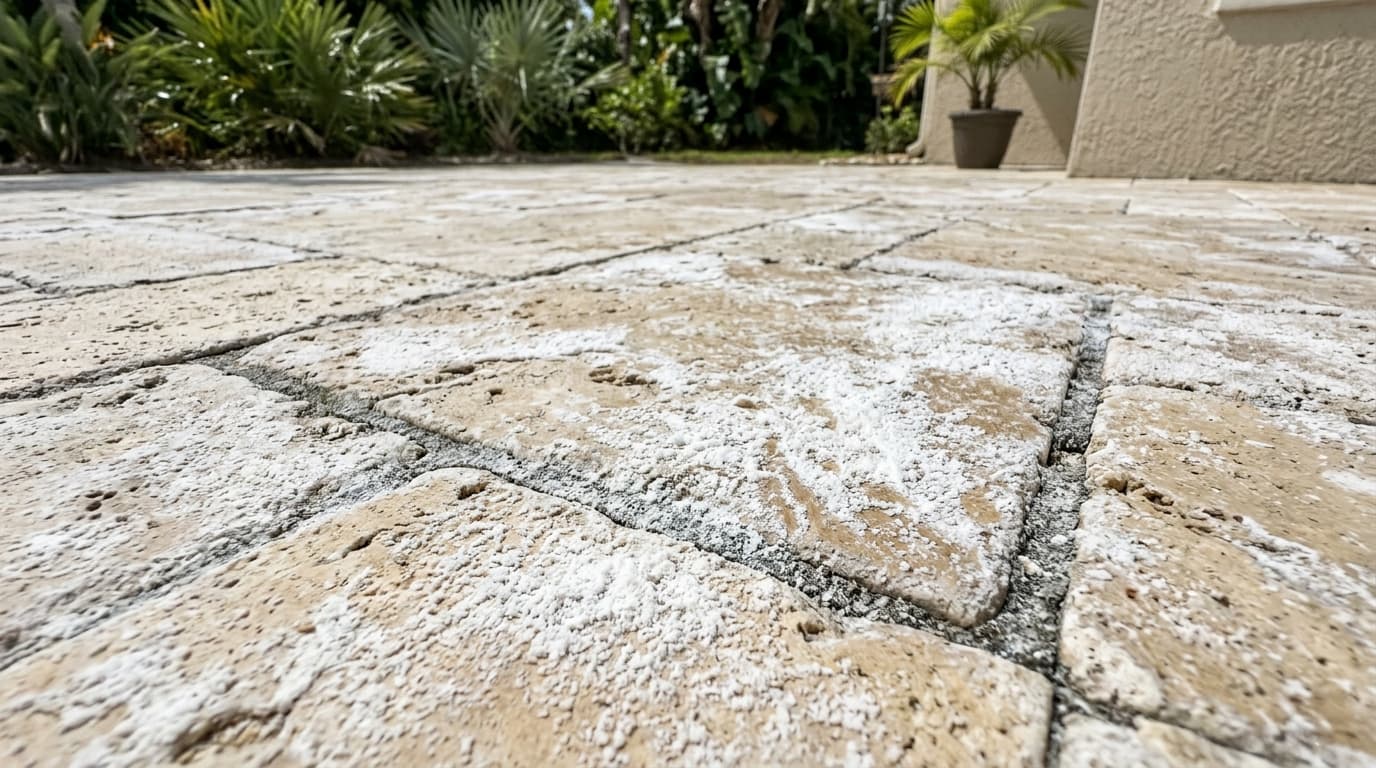
- Check for moisture: Note whether the crack becomes damp, changes color, or produces white crystalline powder (efflorescence).
- Inspect surrounding doors and walls: Check for sticking doors, cracked tile, drywall tears, or perimeter gaps.
- Do not apply caulk or patch compound blindly: DIY topical patch can hide valuable forensic evidence that a specialist needs to diagnose the true cause.
- Schedule an inspection: If the crack is leaking, wider than a dime edge, moving, or in a primary floor, consult a professional.
Why Tampa Bay Property Owners Choose Tampa Terrazzo
- 48+ years of Florida experience: Restoring terrazzo, stone, and concrete floors across Tampa Bay since 1978.
- Diagnosis before prescription: We identify why the crack occurred before recommending repair, and we will tell you plainly if injection is unnecessary.
- Flooring-level finish work: We use dustless diamond grinding and polishing to seamlessly blend repaired cracks with concrete and terrazzo floors.
- Transparent estimates: Clear, upfront pricing with zero high-pressure sales tactics or surprise add-ons.
- Local knowledge: We understand Florida subsoils, high water tables, and coastal humidity and how they impact concrete slabs.
- Proven reputation: Rated 4.9/5 stars with 37+ verified customer reviews across Tampa, Brandon, Clearwater, and St. Petersburg.
Ready to Fix That Crack the Right Way?
Send us a photo of your crack. We will analyze what is happening and advise whether epoxy, polyurethane, or simple sealing makes sense before you spend a dime.
Frequently Asked Questions
Which is better, epoxy or polyurethane crack injection? ▼
Neither is better in every case. Epoxy is best for stable, dry cracks where structural strength needs to be restored. Polyurethane is best for cracks that leak, stay damp, or move. The right choice depends on three things: moisture, movement, and what caused the crack.
How much does concrete crack injection cost in Tampa Bay? ▼
Professional epoxy injection typically runs about $25–$65+ per linear foot (roughly $400–$1,000+ per crack). Polyurethane runs about $20–$55+ per linear foot (roughly $400–$800+ per crack). Most contractors charge a $400–$800 minimum service call. Length, depth, access, and finish work change the final price.
Can I use epoxy on a wet or leaking crack? ▼
Standard epoxy isn’t designed for wet cracks and may not cure or bond properly against water. Polyurethane is the better choice because it reacts with water to expand and seal the leak. If structural strength is also needed, a professional can follow up with epoxy once the crack is completely dry.
How long does crack injection last? ▼
Epoxy injection can last 20+ years when the cause of the crack is fixed and the slab is stable. Polyurethane typically lasts 10–15+ years, longer for flexible gels that stay moist. Lifespan depends mainly on whether the repair matches the crack type and its cause.
Can I do crack injection myself? ▼
DIY kits can work for short, narrow, dry, stable cosmetic cracks. They usually fail on structural, wet, moving, deep, or finished-floor cracks. If you can’t tell whether a crack is structural, wet, or moving, get it assessed before buying a kit.
Why do concrete floors crack so often in Tampa Bay? ▼
Sandy soils, a high water table, heavy summer rain, tree roots, and older thin slabs all contribute. Fast drying in Florida heat also causes early shrinkage cracks in new concrete. Parts of Hillsborough and Pasco counties also have sinkhole-prone limestone, though most slab cracks are not sinkholes.
Can cracks in terrazzo or polished concrete floors be repaired? ▼
Yes. Injection stabilizes the crack, and the area can then be ground, filled, and polished to blend with the surrounding floor. Matching the finish is the hard part, which is why finished floors are better handled by flooring specialists than with DIY resin.
Semantic Keynotes & Named Entity Recognition (NER) Tags▼
Semantic Keynotes
- Primary Conceptual Themes: The content focuses on a technical comparison between rigid structural bonding (Epoxy) and flexible waterproofing (Polyurethane) for concrete remediation, specifically tailored to the geoclimatic conditions of the Tampa Bay region.
- User Intent Targets: Targets high-intent property owners seeking diagnostic clarity on whether a concrete crack requires structural “welding” or flexible moisture mitigation.
- Core Value Proposition: Expert-led guidance from a 48-year industry veteran (Tampa Terrazzo) that prevents costly repair failures by aligning material chemistry with the physical state of the crack (wet vs. dry, moving vs. stable).
- Strategic GEO Takeaways: To satisfy Generative Engine Optimization, the content leverages hyper-local geographic signals (sandy soil, high water table, hurricane season) and clear “Quick Answer” modules that prioritize immediate factual extraction for AI-driven summaries.
NER Tags
- ORGANIZATION & BRANDS: Tampa Terrazzo.
- PERSON: Al Spicer.
- PRODUCTS, SERVICES & SOLUTIONS: Epoxy injection, Polyurethane injection, Concrete repair, Hydrophobic (foam) polyurethane, Hydrophilic (gel) polyurethane, Polished concrete, Terrazzo, Decorative overlays, Professional injection, DIY injection kits.
- TECHNICAL SPECIFICATIONS & CODE ENTITIES: Two-part, low-viscosity epoxy resin, Injection ports, Pressure-fill repair, Fast-setting paste, Hydrostatic leaks, Diamond grinding, High-viscosity resin.
- STRATEGIC & FUNCTIONAL CONCEPTS: Structural bonding, Waterproofing, Load-bearing capacity, Flexible seal, Decision framework, Pressure-fill, Quick Answer, Quick reference, Cost comparison.
- INFRASTRUCTURE & SECURITY ENTITIES: Concrete floor, Slab, Garage, Foundation walls, Beams, Columns, Pool decks, Planters, Tanks, Water features, Basement walls, Stem walls, Retaining walls, Concrete block walls.
- CONTACT, CHANNELS & GEOGRAPHIC DATA: Tampa Bay, FL, 1409 Sunnyhills Dr, Brandon, FL 33510, USA, 813-842-2255, bestchoice2022@gmail.com, St. Petersburg, Clearwater, Hillsborough, Pasco, Blog.
Recent Posts

Marble Etching Explained: Causes, Prevention & How to Fix It


Your Go-To Concrete Care Guide

How to Choose the Best Floor Restoration Company
